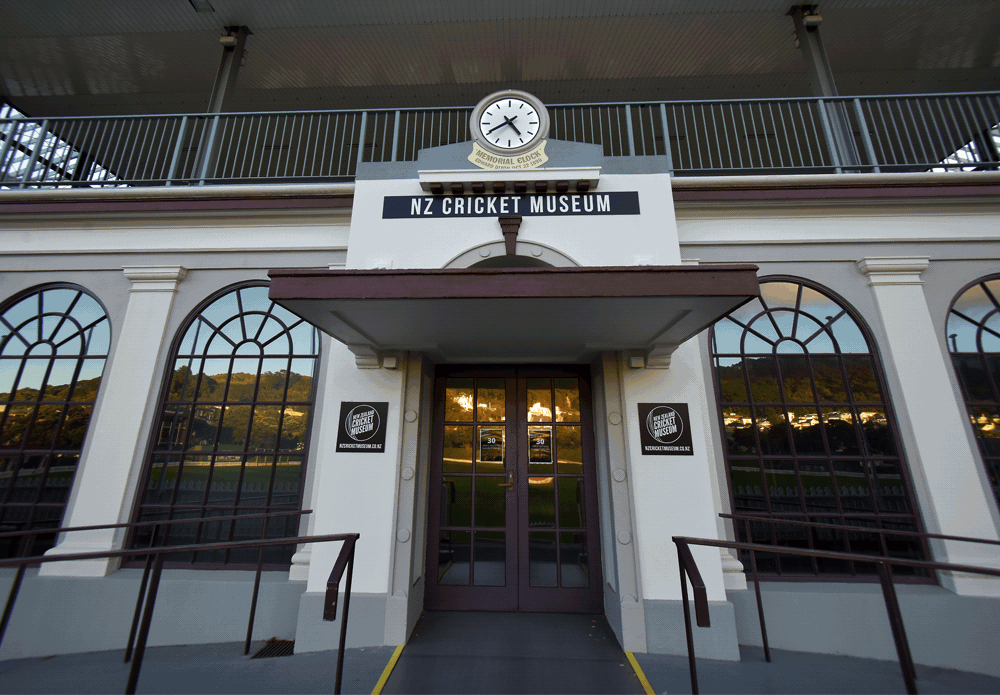
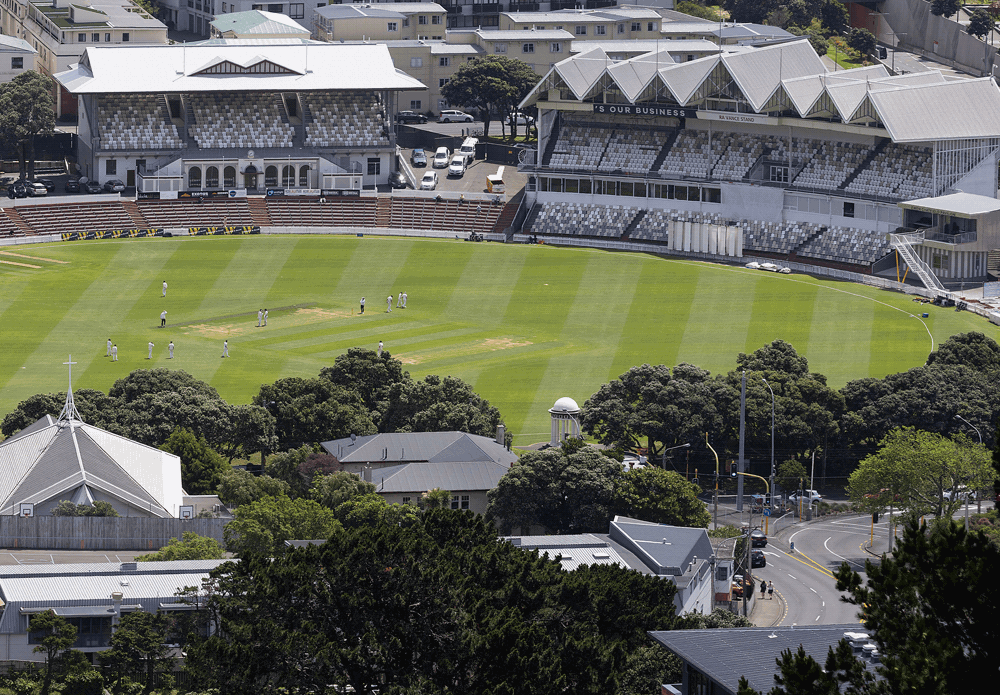
Who has scored the most runs, taken the most wickets and catches at the Basin Reserve? No its not Matthew Bell or Ewen Chatfield. It is the Wellington and New Zealand scorer for the last 47 seasons…….Ian Smith.
Smith will reach the milestone of 200 first-class games on the scorebook this week when he scores the Wellington Firebirds versus Otago Volts Plunket Shield round three four-day match, starting tomorrow at the Basin Reserve.
We caught up with Smith during one of his days in Cricket Wellington’s office at the Basin Reserve working in one of his other roles as Cricket Wellington’s club cricket draws and results administrator (the other is co-editing the New Zealand Cricket Almanack with Francis Payne):

Ian Smith receiving an ICC Spirit of Cricket Medal from Sir Richard Hadlee at the start of last year's New Zealand -India Test match
Congratulations on your pending milestone. You’re sitting on 199 not out, how many Test matches and how many non-international first class matches have you scored?
I have done 42 Test matches and 157 non-international first-class games.
Wow that’s a lot of cricket, have you missed any Test matches since you did your first one?
Yes, I have missed one Test match, and that was in 1990 when New Zealand played Australia here. Two days before the game the whole ground was flooded. The game eventually got underway and New Zealand won by 9 wickets. But I missed that because my wife was ill at the time – but that is the only Test I’ve missed.
Do you know how many domestic and international One-Day and Twenty20 games you’ve also scored at?
I worked out that I have scored 180 One-Day games, which includes 42 ODIs. So the number of Tests and ODIs that I have scored are level at the moment. I have also done about 25 Twenty20 games.
What’s your background and how did it all start?
As a youngster in England my father looked after a navy side in Chatham. And I used to tag along and run the scoreboard. Also at times I did a little bit of scoring there. When I came here I had played cricket at Wellington College and then started working for Lever Brothers and played lower grade cricket. I scored 49 in the first game and 36 the next game. However in the next five innings I faced six balls so I thought to myself maybe you’re not going to get very far. There was one week soon after where we had a surplus of players so I opted to stand down and instead went through the Mt Victoria tunnel to Kilbirnie. I had met Trevor Rigby in those days through my association with soccer and I ended up scoring for Kilbirnie [now Eastern Suburbs]. I think I had 11 seasons there. Previously when I was at Wellington College one of the guys was working on the Basin Reserve scoreboard and got me involved there. That was the 1959/60 season when I started working on the scoreboard.

Where it all began foor Smith: The scoreboard on the eastern side of the ground and the Scorer's box that he graduated to. This photo is of Bob Blair bowling for New Zealand against England in 1963, two years before Smith's first Test as a scorer. Alan Smith is the bastsman and Barry Sinclair is fielding at cover.
Great, so your career at the Basin Reserve started on the scoreboard. Can you recall when you debuted on the scorebook in a first-class game?
My first first-class game was Wellington versus Canterbury in January 1964. At the time Wellington had quite a good side because the game finished inside two days with victory to Wellington [Wellington won by 9 wickets – Bob Blair and John Reid combining to skittle them for 78 in their second innings].
When was your first Test?
My first Test was the following season, and that was New Zealand versus Pakistan in 1965. It was a drawn game. New Zealand had scored 266, but they gave a pretty good impression for later teams to follow because at one stage they were 261 for 4! JR Reid scored 97 and from a personal point of view Barry Sinclair got 75 and he played for Kilbirnie. In that game Bevan Congdon made his Test debut and there was a young gangly fast bowler called Richard Collinge, who at the time was playing for CD but later came to Wellington and also joined Kilbirnie.
You’ve seen 42 Tests and 42 ODIs. What memories stand out from those?
I think my most memorable Test was in 1978 when New Zealand beat England for the first time. England needed 137 runs to win in the fourth innings and Collinge bowled Boycott with the fourth ball of his first over. This triggered a rapid collapse that saw England 53 for eight at stumps. The Game finished well before lunch on the fifth day. Amongst the celebrations afterwards one thing that stood out for me was seeing Bert Sutcliffe with tears in his eyes, which highlighted how special the victory was as Bert had never played in a New Zealand Test winning side in all his 42 games.
I know that Richard Hadlee’s 7 for 23 against India in 1976 was a special bowling performance, but the guy who impressed me more than anyone was Courtney Walsh in 1995. The West Indies had scored about 600 on a flat track with nothing in it for our bowlers and then Walsh came out and took 13 wickets and rolled New Zealand. At the time he was the world record holder for most number of wickets and it showed.
I think the best batting performance in Tests would have to be the Martin Crowe – Andrew Jones (then) world record 467 partnership in 1991 against Sri Lanka.
Are there any special memories from the 157 non-international First-Class games you’ve scored?
In 1979/80 the Basin Reserve was closed due to major renovations and realignments, and Wellington played a game against the touring West Indies at the Hutt Recreation Ground. Wellington won by 6 wickets mainly due to Ewen Chatfield getting 13 wickets. Chats destroyed them on that wicket and took 6 for 33 and 7 for 53. He took 49 wickets for Wellington that season.
In the 1988/89 season Bruce Edgar shared in consecutive opening partnerships of over 300 runs. The first with Andrew Jones, the second with Robert Vance. They stood out. Also, the last game of that season Wellington were playing Canterbury here and this was a season or so after the game in Christchurch in which Vance bowled a 22 ball over. Again, in an effort to try and achieve a win, Wellington gave a few runs away and the game ended up as a very rare tie.
Are there any characters of the game that spring to mind?
From scoring colleagues, the touring English scorers all seem to have noted senses of humour. For example, there was a guy called Clem Driver who scored for Essex. Clem had the MCC scorebook and it was nothing for him to turn around and add a bit of drama in the book so as when people at Lord’s etc looked at it. For example someone was walking past the site screen and it caused a stoppage and Clem put down in the book ‘Crowd Disturbance. Near Riot.’
From a players point of view, it’s the guys who go out of their way to thank you that always stand out and leave a good impression, particularly at club level where the scorers are often the forgotten people and one of their main roles seems to be to look after valuables. In recent times, a player that has stood out in this capacity has been former Wellington batsman and latterly Auckland Aces captain Richard Jones. Jonesy to me was a great guy because at the end of every first-class game or every day’s play of club cricket he always came and thanked us.
The umpire that I got on particularly well with was Steve Dunne. Steve and I could have quite a few chats and we’d discuss things between ourselves. Steve was on the first ICC international panel and he was also the first guy to umpire 100 ODIs. Additionally, since the scorers went into the umpires’ association I’d have to say that we’ve been a lot closer. Where as previously you had to get to know these umpires, we’re all a lot closer now.
Any hairy moments on the scorebook?
No major mistakes, but you do get a few things wrong. I would venture to say that if there’s a scorer who has never made a mistake I don’t think he’s been born! But minor mistakes happen and as long as you correct them that’s fine.
With the advent of One-Day and now Twenty20 cricket as obvious examples, the game’s changed tremendously in your time. How have the changes impacted upon the role of the scorer?
I think it’s a case that with the Twenty20 and One-Day cricket the scorer has got to be even more alert at all times. In first-class and even One-Day cricket if I am scoring on a computer I can run a scoresheet at the same time as a backup. But in Twenty20 – although it is theoretically being played at the same rate as a 50-over game – there’s more going on so I can only really concentrate on one thing.
Another change is the speeding up of the game with over rates. When I first started the fielding team could and often did slow the game right down to a crawl to prevent the batting side from forcing a result. The parameters of play were on time only, but now with over rate requirements for the bowlers the game’s mostly played a faster tempo than it used to be.
The relatively recent arrival of technology has also changed all aspects of the game and not least the scorebox?
That’s right. But I am not a geek and I know how to operate a computer and that’s it. If something goes wrong I have to call for help. When it’s all working though, computer scoring is great – the computer does the work for you. The only problems you have is if something goes wrong and that’s when you have to keep another linear scoresheet so you can keep going while the mistake is being fixed. It’s the little mistakes that cause just as big a problem as the meltdowns, with things as innocuous as spelling of names or initials of names in the databases that can throw the live computer scoring into all sorts of disarray. So there is still very much a role for the old fashioned scorebook and that will always be the case. In fact I believe that anyone who does live scoring on the computer must also be competent on a book as well; you can’t have someone who just does it on a computer. Conversely you can have people who are perfectly happy just doing it in a book and don’t need to go near the computer if they don’t want to.
The live scoring that we do now has also changed the way people follow the game. Nowadays people can just go on to the internet and pick up the score live, and can get a full scoreboard updated as it’s unfolding. But as recently as 10 years ago you had to wait until the paper came out the following day or tune in to the radio and listen intently for the commentators to broadcast the scoreboard. In that respect, the only person who regularly gives the scoreboard details over the radio is [Canterbury-based commentator] Peter Sharp. He makes certain every time he goes on air that he gives the full scoreboard for the benefit of people who haven’t been able to see it on the computer.
What about the use of technology assisting your interaction with the umpires?
The use of walkie talkies between us and the umpires out in the middle is a big help. We’re now in communication with what’s happening out in the middle, which generally eradicates any confusion. Additionally we can guide the umpires if they miscount an over for instance.
You’ve covered the vast majority of your scoring at the Basin Reserve. Tell us where the scorebox used to be prior to the 1978/79 season when the ground was redeveloped?
The scorebox used to be on the western bank in front of the Mt Victoria tunnel about where the Wakefield Memorial is now [which got moved inside the ground a few years ago]. There was an elevated scoreboard and then there was a scorebox that doubled as a media area where the scorer sat in the front row and there was room behind for about five pressmen. From there we moved to the scoreboard at the southern end of the ground when we resumed back at the ground in 1980/81. We were there right up until last season when we moved up a room in the new media centre in the RA Vance Stand, and is also a logical place for us to be. Being where we are now we have the scoreboard in full view in front of us and we can direct the scoreboard operators if they make errors. Previously they could be making mistakes all over the show and we wouldn’t have known as it was all being changed above us. Needless to say we fielded frequent phone calls asking us to amend various figures and spellings of names.
As well as scoring and your job in the Cricket Wellington office running the club cricket draws and results, another role you have is of co-editor of the New Zealand Cricket Almanack with Francis Payne. How long have you been doing that and what does that involve?
Our first New Zealand Cricket Almanack was the 1983 edition, and we’ve just published the 2010 one, so 27 years and counting. I do a lot of the write ups for international tours and also the One-Day stuff and some of the statistics. Francis does the write-ups for the Plunket Shield and also takes care of most of the happenings and much of the statistics and updating of records.
Is there anyone to credit for your long career?
I think I’ve been lucky so far with my wife Elizabeth having had a sporting background and always been fully supportive. She was involved in cricket as a spectator from the early days because my brother in law played for Wellington in 1960/61. So cricket has been in her blood and she’s also encouraged me since we got married.
Another 100 games after this one do you think?
No I don’t think I’ll be doing it in 24 years time! This is my 48th season, so I’d like to be able to reach 50 seasons. I don’t know how many balls I would have done in that time, but I’d like to reach my half century of seasons and then take it from there. There is always the lure of the World Cup in five years from now so who knows how long I’ll keep at it?